
Life Between the Leaves
Big thanks to the Macon Arts Alliance for their support. They have a great team who have been able to curate a lovely space for showcasing this body of work. Thank you for the opportunity to show at your gallery!
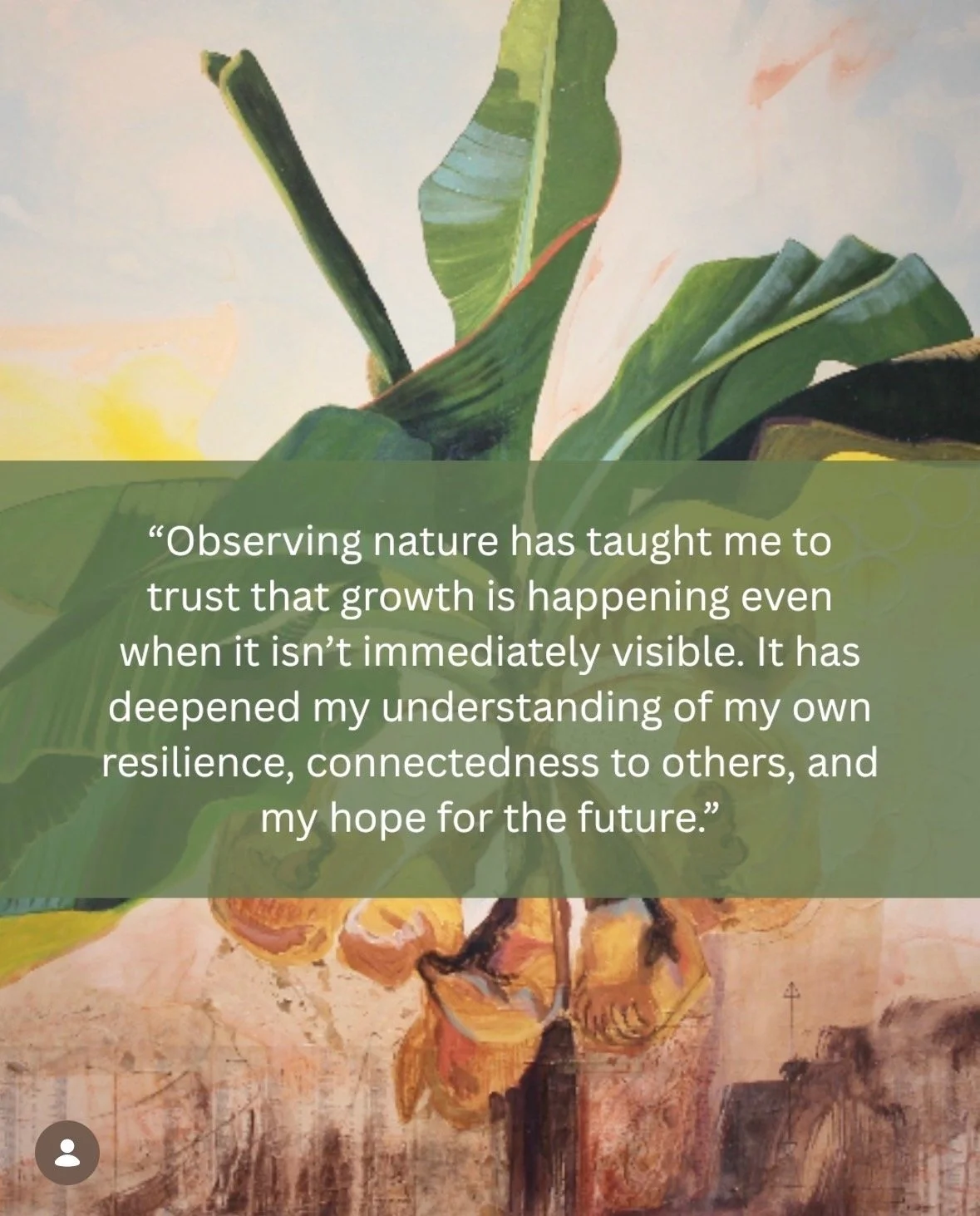
You may not know it, but your life and the life of a tree have more in common than you might think. Courtenay Raffalovich noticed this connection while observing an unassuming banana tree, and it evolved into “Embodiment”, a beautiful mixed media series that documents the banana tree’s stages of growth and how they mirror the human experience. Like us, trees endure periods of adaptation, struggle, transformation, decay. “Embodiment” is Courtenay’s invitation to viewers to take a closer look at the banana tree and find pieces of themselves in each leaf, root, and fruit.
Tell us a little about yourself. Who are you, and what do you do?
I am originally from Lawrenceville, GA and I can remember from an early age that art has always been a part of my family. It was only natural to take art classes in high school and continue my artistic studies at the University of Georgia.
I graduated with a major in Art Education with a concentration in Drawing and Painting because it combined my passions: art and teaching. I also realized that as an Art Educator, it was important to work and hone my skills as an artist.
Artistically, I am a Mixed Media artist and find my inspiration in nature and spiritual concepts. My work can be described as contemporary, abstract, and whimsical. I use expressive marks and layers of fabric, papers, conte, acrylic inks, and acrylic paint together in fresh compositions to create joyful and peaceful paintings. I enjoy working in series and creating concepts for exhibitions, like my current show, “Embodiment: A Reflection” at the Macon Arts Alliance.
“Embodiment” is about the human experience reflected through the life cycle of the banana tree, with stages like emergence and regeneration mirroring our own life cycles. Has nature always played a role in your art? How has observing nature helped you learn more about yourself and the human experience?
Nature has always inspired my artwork, but this series grew from a season of paying closer attention to the internal lessons life was teaching me. As I observed a banana tree near my home, I came to realize it was offering a connection to my own experience. What began as simple admiration for its beautiful forms evolved into a fascination of how its life cycle mirrored the human experience. It endures storms, adapts to changing conditions, bears fruit, and eventually gives way to new growth.
Observing nature has taught me to trust that growth is happening even when it isn’t immediately visible. It has deepened my understanding of my own resilience, connectedness to others, and my hope for the future. For me, these patterns also point to a larger spiritual truth—that life is continually unfolding, and even endings can become the beginning of something new.
“Embodiment” grew out of that recognition and invites viewers to see their own stories reflected in the natural world.
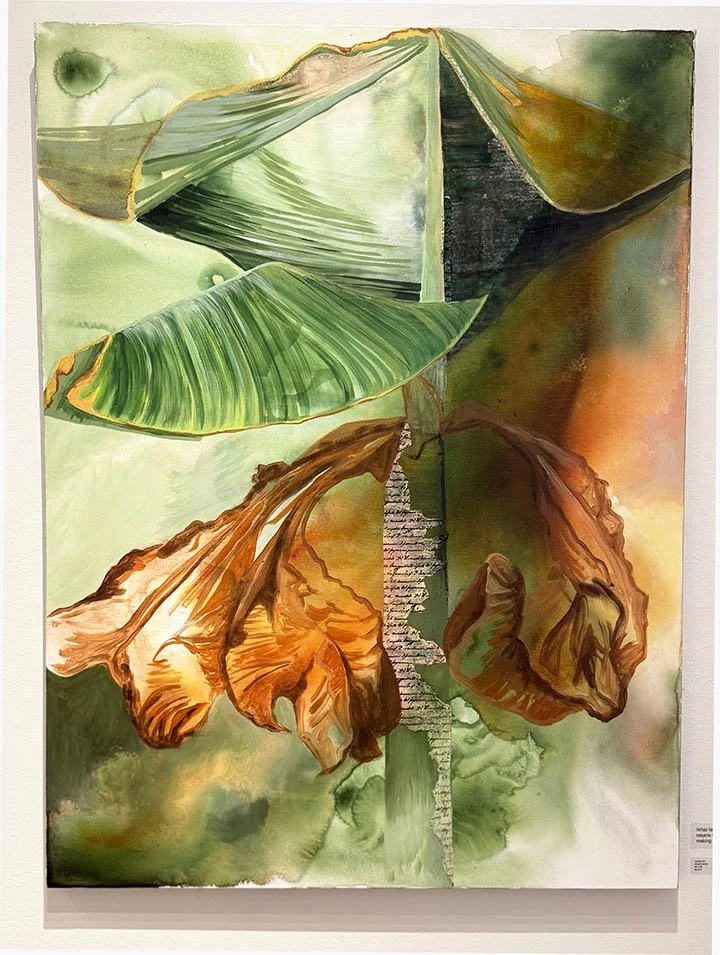
“Letting Go”
Many of your works in this series are mixed-media, featuring maps, pages torn from books and manuals, and hand-written letters. What was your process in finding the right materials that would work with each painting?
I usually have a general sense of the color palette and mood I want to create before I begin a painting. The first step is selecting inks that correspond to that feeling. I pour and layer the inks onto the canvas, allowing them to merge, move, and dry naturally. This stage is spontaneous and requires a certain amount of surrender. It is the part of the process where I release control and allow the work to become what it wants to be. I let the inks play without restricting their movements.
Once the inks have dried, I begin building the composition with paint. The final step is incorporating paper elements. Over the years, I have collected a growing archive of interesting papers from estate sales, old books, manuals, maps, handwritten letters, and papers I’ve created myself. I love using these materials because of their versatility. They can provide texture, pattern, color, shape, or even a sense of history, depending on what the painting needs.
There is also something meaningful to me about giving discarded or forgotten materials a new life. Just as the themes in “Embodiment” explore growth, transformation, and renewal, these papers are transformed and given a new purpose within each work. I manipulate them in whatever way best supports the subject, allowing them to become an integral part of the story each painting tells.
How do you think the life cycle of the banana tree compares to your own artistic process?
I see many parallels between the life cycle of the banana tree and my artistic process. Like the tree, each painting begins with a period of emergence, an idea, a feeling, or a question that starts to take root before I fully understand where it will lead. As the work develops, there is a season of growth where layers are added, decisions are made, and the composition gradually reveals itself.
One of the things I admire most about the banana tree is its resilience. It bends in storms, adapts to its environment, and continues growing despite challenges. My artistic process often feels the same way. There are moments of uncertainty, failed experiments, and unexpected changes in direction, but these experiences often become essential to the final work rather than obstacles to it.
The banana tree also reminds me that growth is cyclical rather than linear. As an artist, I experience similar cycles of completion and renewal. Finishing one body of work often created space for new questions, new ideas, and new directions to emerge. Each series builds upon what came before it, carrying forward lessons learned while making room for transformation and growth.
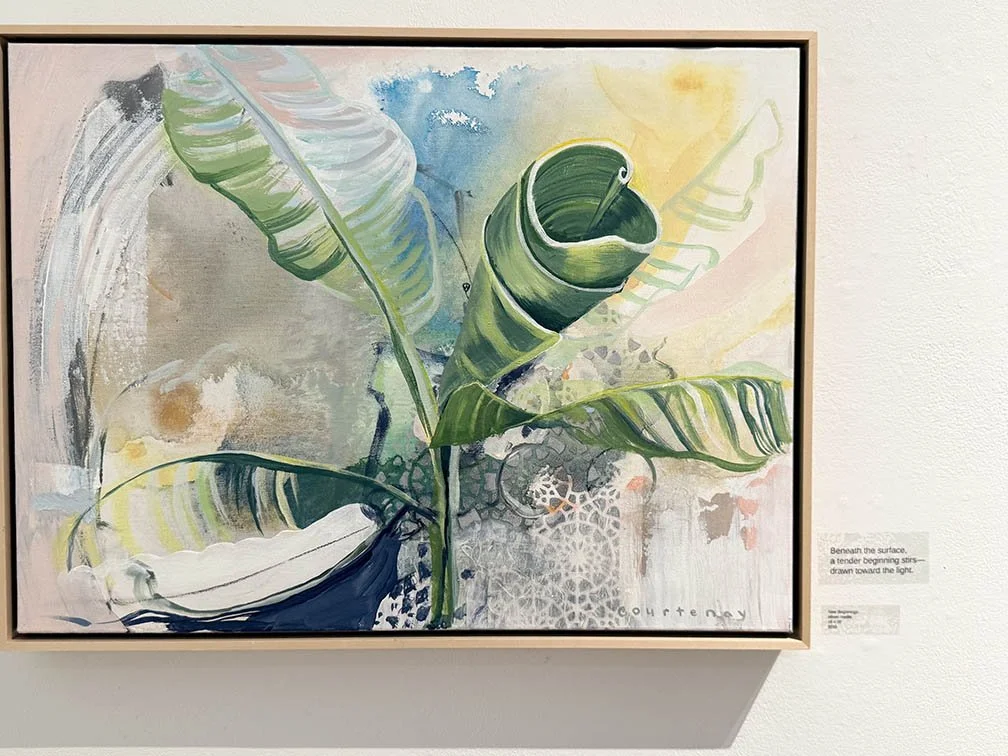
“New Beginnings”
Are there any future projects you’re working on or are planning to work on?
For now, I plan to continue exploring this subject matter because I feel there is still more to discover within it. The banana tree has become a rich metaphor for me and I don’t feel finished with the conversation yet.
While this exhibition has focused primarily on painting, l’m interested in expanding the series into other mediums, particularly drawing and printmaking. Exploring the imagery through those processes will allow me to investigate different aspects of the subject and continue to develop the ideas that emerged through “Embodiment”.
What keeps you motivated to create, and how do you stay inspired?
What keeps me motivated to create is that artmaking feels like an essential part of who I am. It gives me a voice and creates space where I can be fully present—with the work and with myself. There is an intuitive pull toward creating that is difficult to explain. Ideas, feelings, and questions seem to press on my until I make time to bring them into the world.
What continues to inspire me is the opportunity for discovery. Every time I begin a new piece, I learn something about the subject, the process, or myself. Artmaking is one of the few experiences in my life that allows me to find myself and lose myself at the same time. It requires deep self-reflection, yet it also invites me to move beyond myself and connect with something larger. As long as there is beauty in the world, shared experiences to have, and the One who holds it all together, I will continue to make art.
“Embodiment” is available to view at the Macon Arts Gallery from now until Friday, June 26. Plus, don’t miss out on an exclusive Artist Talk with Courtenay and 478 Creatives this Thursday, June 18, from 6:00 to 7:30 pm!